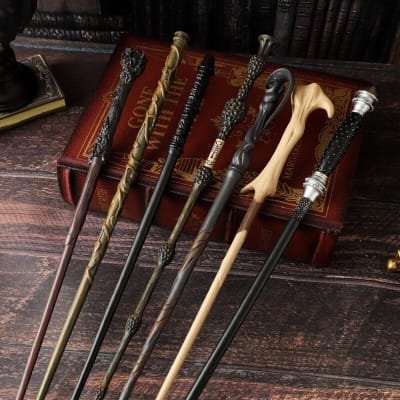
Throughout the long course of human civilization, handmade wands have always carried a dual significance that transcends the boundary between reality and fantasy. They are not only spiritual totems of ancient peoples’ reverence for nature, concrete carriers of medieval mysticism, and works of art inheriting the craftsmanship spirit of modern artisans, but also have now become popular cultural consumer goods in the cross-border e-commerce field. From the rough polishing of wooden branches to the exquisite carving of patterns, from the use of a single material to the integration of diverse crafts, the development history of handmade wands is not only a vivid epitome of human dialogue with nature and coexistence with imagination, but also coincides with the upgrading demand of the global consumer market for personalized, spiritual and cultural products, providing a unique product track for cross-border expansion.
### I. Origin: Primitive Embryo Under Nature Worship (Ancient to Archaic Period)
The origin of handmade wands can be traced back to the nature worship of ancient peoples. In the era of extremely low productivity, humans were full of awe for natural phenomena such as wind, rain, thunder and lightning, birth, old age, illness and death, believing that plants such as trees and vines carried the mysterious power of heaven and earth. They selected tall and uniquely shaped branches from the forest, simply cut off the twigs and polished them smooth to make the earliest “wands”. At this time, handmade wands had no complex craftsmanship, and even retained the texture of the bark and the natural curvature of the branches. Their core significance was to serve as a medium for humans to communicate with gods and nature.
In Neolithic sites, archaeologists have discovered polished peach wood branches and willow branches, some of which still have simple carvings. It is speculated that they were ritual artifacts used by primitive tribes, which are the embryos of handmade wands. The artisans at that time—mostly shamans or elders in the tribe—followed strict natural laws when selecting wood, such as cutting peach wood on a full-moon night and picking willow branches before the morning dew dried, believing that this could absorb natural aura to the greatest extent. Handmade wands during this period were essentially the materialization of primitive religious beliefs and the initial attempt of humans to control unknown forces.
### II. Development: Technological Advancement Endorsed by Mysticism (Middle Ages to Medieval Period)
Entering the Middle Ages, with the progress of human civilization, mysticism, astrology and alchemy gradually emerged, and handmade wands ushered in the first dual upgrade of craftsmanship and connotation. Handmade wands during this period were no longer simple polished wooden branches, but began to integrate more materials and crafts, becoming “artifacts” carrying complex mystical concepts.
In terms of material selection, artisans were no longer limited to common woods such as peach wood and willow wood, but began to use woods with higher hardness and more unique textures such as walnut, oak and yew. At the same time, to enhance “magic power”, they would inlay gemstones, metal wires, feathers and other materials into the wands—ruby symbolizes power, sapphire represents wisdom, and silver wire implies purity. The integration of these materials enriched the shape of handmade wands. The combination logic of “material implication + craft symbol” formed during this period has become the core design inspiration source for contemporary cross-border handmade wands. For example, the best-selling crystal-embedded wands overseas continue the tradition of gemstone empowerment. In terms of craftsmanship, carving technology began to be applied. Artisans would carve spiral patterns, star patterns, runes and other patterns on the handle of the wand. These patterns were not randomly designed, but corresponded to specific spells and rituals, and each cut contained mystical logic. This “symbolic craftsmanship” can quickly arouse the emotional resonance of overseas consumers with Western mystical culture, and is one of the core competitiveness of cross-border products.
In medieval Europe, handmade wands became iconic tools for wizards and alchemists, and the production process became more refined. At this time, special artisans engaged in wand making appeared, who were called “wandmakers”. They made wands for nobles and churches (secret mysticism researchers) relying on inherited skills from generation to generation. Handmade wands during this period paid attention to proportion and balance, mostly 30-40 centimeters in length, with thick handles for easy holding and gradually tapering wand bodies to facilitate energy concentration. Some high-end wands also adopted gilding, inlay and other crafts, making the wands not only have “practical value”, but also become a symbol of identity and status. It is worth noting that the production of handmade wands during this period was endowed with a strict sense of ritual. Every step from the selection of wood, the matching of materials to the final consecration of the finished product followed a fixed process, demonstrating reverence for mysterious forces.
### III. Transformation: Functional Restructuring Under Rational Thought (Renaissance to Industrial Revolution Period)
The rise of the Renaissance made rational thought gradually replace the dominant position of theology and mysticism, and the development of handmade wands also ushered in a transformation. During this period, people’s belief in “magic power” gradually faded, and the function of handmade wands began to shift from “artifacts” to “tools” and “decorations”.
In the academic field, handmade wands became auxiliary tools for scholars and astronomers, used to point to the stars and measure angles. At this time, the wands paid more attention to practicality and accuracy. Artisans would use wood with high hardness and no easy deformation, and carefully polish it to ensure the wand body was straight. Some also inlaid metal probes at the tip of the wand to improve measurement accuracy. In the art field, handmade wands became part of court decorations. Nobles were keen to collect uniquely shaped and exquisitely crafted wands. Artisans gave full play to their imagination and integrated various artistic techniques such as carving, painting and inlay, making the wands works of art with both ornamental and collection value.
During the Industrial Revolution, machine production began to become popular, but handmade wands were not replaced by machine production due to their unique artistry and personalization. On the contrary, the scarcity of handcraft made handmade wands more sought-after. This characteristic has continued to this day and become the core advantage of handmade products in cross-border e-commerce compared with mass-produced goods. Artisans during this period began to focus on personalized customization, selecting wood and designing shapes according to customer needs. Some wands were also engraved with exclusive logos such as customers’ family crests and initials. This personalized thinking is highly consistent with the mainstream trend of “personalized services” in contemporary cross-border e-commerce. At the same time, with the development of global trade, artisans had more opportunities to come into contact with exotic materials, such as red sandalwood and mahogany from the East, and black walnut from the Americas. The enrichment of materials further promoted the diversified development of handmade wand craftsmanship, and also laid the foundation for the material innovation and cultural integration of contemporary cross-border products. For example, the cross-border design combining Eastern peach wood and Western crystals is very popular on platforms such as Etsy.
### IV. Revival: Inheritance of Craftsmanship Spirit and Cultural Resonance (Modern Period)
Entering modern society, with the rise of fantasy literature and film and television industry, handmade wands have ushered in a revival again, and have achieved a breakthrough in the global market with the help of cross-border e-commerce. Fantasy works represented by the “Harry Potter” series have made handmade wands a symbol of global pop culture. On social media platforms such as TikTok and Instagram, the topic #crystalwand has accumulated over 10 million views. Related content such as unboxing and usage scenario sharing has become a traffic hotspot, bringing a natural traffic foundation for cross-border sales. More and more people have begun to pay attention to and love handmade wands, promoting the inheritance and innovation of production techniques, and spawning a huge global consumer market—on platforms such as Etsy and Amazon, the price of handmade wands ranges from tens of dollars to thousands of dollars, and the monthly sales of popular styles can reach thousands of pieces. The core consumer group is young people aged 18-35, who pursue personalized expression, are keen on spiritual consumption, and are willing to pay a premium for the cultural connotation and emotional value of products.
The production of modern handmade wands not only inherits the essence of ancient craftsmanship, but also integrates modern design concepts and technologies, and forms precise product strategies according to the needs of the cross-border market. In terms of material selection, artisans still follow the principle of “harmony with nature”, focusing on the natural texture and characteristics of wood, while boldly trying modern materials such as resin and glass. They also combine the global spiritual consumption trend, focusing on selecting crystal materials with clear emotional implications such as amethyst (aiding spirituality), rose quartz (symbolizing love) and citrine (implying wealth), to accurately match the spiritual needs of overseas consumers. In terms of craftsmanship, traditional carving and inlay techniques are retained and upgraded. Artisans use sophisticated tools to carve complex and delicate patterns, and at the same time introduce modern technologies such as laser engraving and 3D scanning, which not only ensure the precision of craftsmanship, but also efficiently realize personalized customization—such as engraving exclusive runes according to customers’ constellations and needs. This customization service can significantly increase the product premium space. In addition, in response to the needs of cross-border transportation, modern handmade wands pay more attention to portability in size design, with most products controlled at 30-45 centimeters. At the same time, environmentally friendly buffer packaging is adopted to reduce transportation losses and meet the environmental packaging standards of European and American markets.
Today, handmade wands have completely broken through the category of “artifacts” and “tools”, and have become popular cross-border products with cultural carriers, artistic expression and commercial value. A large number of artisan studios focusing on handmade wands have emerged around the world. Relying on the cross-border e-commerce ecosystem, they promote their products to the global market through the model of “social media seeding + independent station/platform transactions”. From the perspective of product positioning, it is mainly divided into three core tracks: first, IP co-branded models, which replicate classic film and television shapes such as “Harry Potter” to meet the collection needs of fans. Such products perform prominently in the holiday gift market; second, spiritual healing models, which highlight concepts such as crystal energy and natural empowerment, and are matched with scenario descriptions such as “meditation assistance” and “space energy optimization” to fit the overseas spiritual consumption trend. It should be noted that Eastern metaphysical concepts need to be converted into expressions easily understood by the West to avoid cultural barriers; third, decorative ornament models, which focus on visual designs such as ins style and retro style, and become photo props and home decorations with their high appearance. Such products need to strengthen visual display and highlight texture through high-quality pictures and texts.
From the ancient natural totem to the modern cross-border hit product, the thousand-year development history of handmade wands has always been inseparable from the craftsmanship spirit carried by the word “handmade”, and cross-border e-commerce has endowed this craftsmanship spirit with broader commercial vitality. In the era dominated by machine production, the cross-border value of handmade wands lies not only in their unique shape and craftsmanship, but also in their accurate matching of the emotional needs and personalized pursuit of global consumers—overseas consumers buy not only a product, but also a spiritual sustenance, a cultural experience and a way of self-expression. This consumption logic of “emotional value > cost value” is the core reason why handmade wands can achieve high premiums. To gain a firm foothold in the cross-border market, attention must also be paid to compliance details: it is necessary to pass relevant certifications such as the EU REACH Regulation and the US CPSIA, complete the detection of harmful substances such as heavy metals and formaldehyde, and ensure material safety; packaging labels must clearly indicate materials, origin and safety warnings, and provide multi-language instructions. In the future, with the continuous inheritance and innovation of the craftsmanship spirit and the continuous improvement of the cross-border e-commerce ecosystem, handmade wands that accurately integrate Eastern craftsmanship and Western culture will surely write a more wonderful commercial story in the global market.